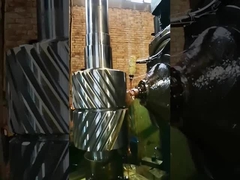
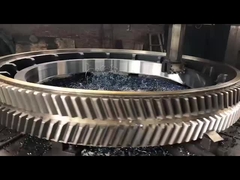
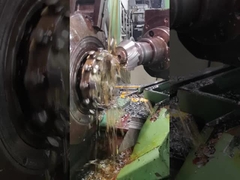
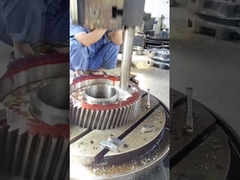
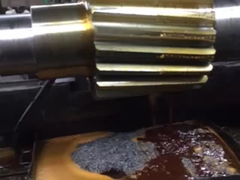
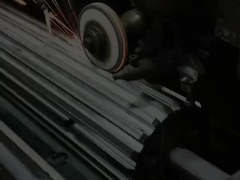
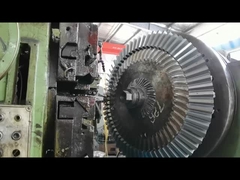
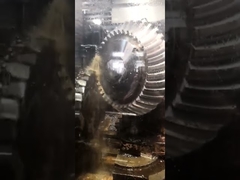
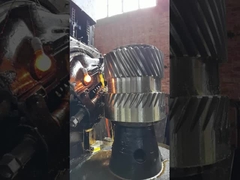
Brief: See the journey from feature description to real application in this concise overview. This video demonstrates how double helical gears deliver smooth power transmission in heavy-duty industrial machinery, showcasing their unique design that balances axial forces and enables high torque handling.
Related Product Features:
Symmetrical V-shaped tooth profile with opposing helix angles that self-balance axial forces.
Eliminates the need for additional axial positioning structures, reducing bearing loads.
High load-carrying capacity with 40%-60% larger tooth contact area than equivalent spur gears.
Transmits exceptionally high torque, suitable for thousands to tens of thousands of Newton metres.
Superior transmission smoothness with progressive engagement and minimal impact.
Low vibration and operational noise levels 10-15dB lower than spur gears.
Excellent structural rigidity with symmetrical design reducing gear deformation.
Adapts to prolonged heavy-duty operation in demanding industrial applications.
FAQs:
What are the main advantages of double helical gears over single helical or spur gears?
Double helical gears offer self-balancing axial forces, higher load capacity with 40%-60% larger contact area than spur gears, superior smoothness with lower noise (10-15dB reduction), and excellent structural rigidity for heavy-duty applications.
In which industrial applications are double helical gears typically used?
They are ideal for heavy-duty equipment requiring high torque transmission and smooth operation, including large rolling mills, mining crushers, marine main engine gearboxes, large generator sets, heavy construction machinery, and cement rotary kilns.
What manufacturing processes and quality standards are used for these gears?
Our double helical gears are manufactured using gear milling and hobbing processes with teeth grinding, heat treated through carburizing/cement quenching, and achieve high accuracy grades of ISO 6 or AGMA 11 for reliable performance.